Today, May 22, is World Goth Day, a day to celebrate and extol goth music (in all its derivations) and the goth subculture. I came upon a post on the Instagram page of The Darkness Calling (https://www.instagram.com/darknesscallingofficial/?hl=en), a page dedicated to goth/darkwave/electronic music. The page is itself the passion project of Jae and raises money for the Trevor Project (https://thetrevorproject.org/) by securing various bands to contribute songs to compilation albums ( https://darknesscalling.bandcamp.com/)
In the post Jae revealed how the goth movement provided a welcome home and refuge for a non-binary individual. And, those comments spurred me to think about what the entire punk, post-punk, and alternative movement has meant to me (goth is an offshoot of this wider movement) and beyond that to anyone who just doesn’t check all the socially expected boxes.
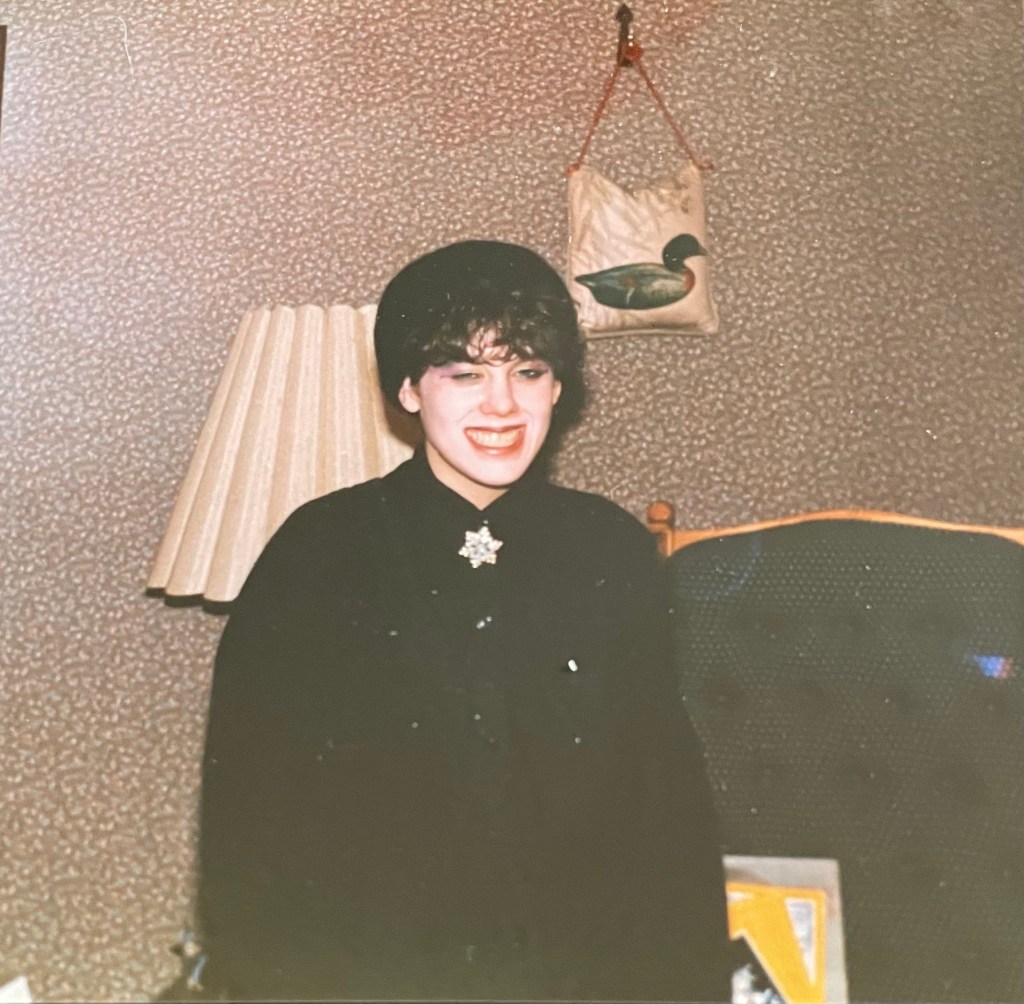
As a young teen girl in the early 1980s who adored literature, classical music, and teddy bears and who had zero interest in getting stoned, looking at teen fashion magazines, being a cheerleader, or lusting after jocks, the music we now identify as post-punk resonated with me on multiple levels. The synthesizers sounded like violins, the bands wore interesting clothes, and there were deep, profound lyrics.
Hanging with my teddy in the summer of 1983
You see, I was that weird kid who read literature all on my own without prompting. Dickens, the Brontë sisters, Shelley, Stoker, Christie, and then later Waugh, Forster, Camus, Orwell, Cooper, Hawthorne, Orwell, and Huxley were just some of the authors I read independently. Of these, gothic novels were among my favorites. I read Jane Eyre and Dracula several times before I entered high school.
Still reading to this day
As such, when I first came across bands like Siouxsie and the Banshees, Bauhaus, and the Cure, I easily recognized that many of the songs engendered the same kind of “feeling” that gothic novels did—otherworldly, eerie, spooky, unusual. As time went on and I began to study literature more seriously, the connection between post-punk music and literature only grew stronger. “Don’t Stand so Close to Me” and Lolita; “Killing an Arab” and The Stranger; the Queen Mab’s speech in the video for Duran Duran’s “Night Boat;” post-apocalyptic themes in “Black Planet” by The Sisters of Mercy and an obvious reference to Eliot with the Mission’s “Wasteland.”
Before seeing Love & Rockets in 1986
But, the entire punk and post-punk movement contained far more depth than just literary references. At times, it was revolutionary, discursive, digressive, destructive, and groundbreaking as well as thought-provoking. You see it truly had something for everyone, most especially people who “knew” that they just didn’t fit into a mold. From the Pistols’ “God Save the Queen,” to XTC’s “Making Plans for Nigel” to Suicidal Tendencies’ “Institutionalized,” to Frankie Goes to Hollywood’s “Relax,” the songs (and often videos) challenged, overturned, and questioned every single societal, political, and cultural norm.
Before seeing the Ramones in 1986
The punk and post-punk movement certainly wasn’t the first movement to challenge social, political, and cultural norms. The romantics, cubists, flappers, beatniks, and hippies all had their moment in the sun. There’s something a little different about the punk and post-punk movement, though—it wasn’t simply about questioning authority and norms, overturning a social order, protesting injustice, or expressing feelings and identities. The punk and post-punk movement cherished and honed authentic individual experiences. It allowed space for guyliner, drag, straight-edge, nihilism, anger, frustration, despair, unbridled joy, religious and spiritual sentiment, experimentation, and so much more. It allowed people to be themselves, whatever or whoever that might be and told the rest of society to not-so-politely go f*** themselves in the process. That is why it has endured, that is why it still inspires, and that is why I am the way I am.
It’s almost Halloween— a good time to dust off those Cure albums and apply that black eyeliner, maybe even stream a macabre film classic or two because it’s the spooky season and that’s what Goths do. Or is it? And what is Goth anyway? A marauding people famous for sacking Rome? A medieval architectural style? A literary movement? A musical genre? An obsession with memento mori? A subculture with defined and specific parameters?
In truth, the term does encompass all of the above, but I’m not so sure that the term would have gone beyond its historical or artistic roots if the Punk movement hadn’t occurred. In the late 1970s, the explosive and revolutionary energy of Punk created a fertile ground for the emergence of an exciting spectrum of musical genres eventually called New Wave or Alternative—now all folded under the umbrella term, Post-Punk. When MTV began airing music videos in August 1981, a good number of the videos on rotation came from English New Wave bands. And, this is where one also finds the music we now call Darkwave or Goth.
“Spellbound”—a Goth Classic
In the fall of 1981, I watched MTV obsessively and the videos which captured my interest were those from English bands like Duran Duran, Ultravox, and Siouxsie & the Banshees. I knew from the minute that I first saw Ultravox’s “Vienna” and Duran Duran’s “Planet Earth,” that this was definitely my thing. I loved the theatrical makeup of Siouxsie, the sweeping grandeur of Ultravox, and the frilly clothes of Duran Duran.
I sought out information about these bands, turning first to standard rock magazines like Creem and Rolling Stone for more information before finding answers from imported magazines and one very special book. That book was called The Book with No Name and it was a pictographic chronicle of London’s New Romantic scene.
My copy is packed in a box somewhere and as it fell apart years ago, that’s probably the safest place for it to be. The people in that book with their brightly colored, often asymmetrical hair, military jackets, lacy frills, and winged eyeliner fascinated me.
Although as a kid, I’d been a fan of KISS and had seen enough of Bowie and Alice Cooper to recognize that stage makeup and fancy outfits weren’t exactly new, there was something quite different about the New Romantics and that difference lay in both the sound and the subject matter.
To be fair, Bowie probably could be considered one of the founding members of the entire Post-Punk movement. Certainly, his appearance in the “Ashes to Ashes“ video meshed perfectly with the New Romantic aesthetic.
“Ashes to Ashes”—Just a Little Bit Spooky
Even though this song is a companion piece to “Space Oddity,” detailing the sad state of the once heroic Major Tom, if you look closely at the extras in the video, you’ll notice that they look like New Romantics. Gone is the Mid-Century Space Age vibe and in its place is something darker, more eerie, a little more gloomy.
And this is where we begin to see the connection between New Romantics and what later came to be known as Goth or Darkwave. There is also one other touchpoint and that is probably even more fundamental—the term New Romantic itself.
New Romantics were perceived as being a new outpouring of Romanticism, the nineteenth century literary and artistic movement which birthed a slew of amazing poems, dream-like paintings, and suspenseful novels.
Romantics looked to the past, nature, and the otherworldly for inspiration. From Wordsworth’s “Lines Composed a Few Miles Above Tintern Abbey,” (1) to Turner’s depiction of “The Rape of Proserpine,” (2) to the horror of Shelley’s Frankenstein, Romantics sought to capture that which lay beyond the ordinary world.
Something of this spirit could definitely be seen in the New Romantics, whether they dressed in Byron-esque finery, crafted elegiac, dirge-like tunes, or flirted with elements of the macabre. Moreover, at times, the connection between Romanticism and New Romanticism is quite deliberate. Consider the following:
Thou still unravish’d bride of quietness,
Thou foster-child of silence and slow time,
Sylvan historian, who canst thus express
A flowery tale more sweetly than our rhyme:
What leaf-fring’d legend haunts about thy shape
Of deities or mortals, or of both,
In Tempe or the dales of Arcady?
What men or gods are these? What maidens loth?
What mad pursuit? What struggle to escape?
What pipes and timbrels? What wild ecstasy? (3)
Then look at this:
Water was running, children were running You were running out of time Under the mountain, a golden fountain Were you praying at the Lares’ shrine?
But, whoa, oh, your city lies in dust, my friend Whoa, oh, your city lies in dust, my friend
We found you hiding, we found you lying Choking on the dirt and sand Your former glories and all the stories Dragged and washed with eager hands (4)
The first selection refers to a Greek artifact and the second refers to the ruins at Pompei. Similar themes, similar questions, similar sense of wonder and awe at a long-forgotten world. The first comes from 1819, and the second from 1986.
It is important to note, however, that by the time Siouxsie & the Banshees relased “Cities in Dust,” the relationship between the term Goth and bands like Banshees was firmly established. But how did that happen?
World Goth Day (5) is now held annually on the same date as the release of the Banshee’s iconic “Spellbound,” (May 22, 1981), but “Spelbound” wasn’t the first known Goth tune. Bauhaus’ seminal “Bella Lugosi’s Dead” was released in 1979, the Cure’s “A Forest” was released in 1980 and the Banshee’s already displayed Goth leanings in their 1978 album, The Scream. Even the currently vogue Kate Bush (Stranger Things—“Running Up That Hill”) wandered into this territory with “Wuthering Heights” (1978). You can’t get much more Goth than writing a song about a famous Gothic novel!!!
“Wuthering Heights”—Meta-Goth!
Clearly then, the roots of Goth/Darkwave music began in the late 1970s, but the subculture surrounding the music really emerged when Olli Wisdom and Jon Klein of the Specimen began hosting a club night called The Batcave in the summer of 1982. (6). From that point on, the term Goth became linked with certain musical acts and a preferred style of dress with its black funereal clothing and dramatic ghostly white makeup. It was Glam, Penny Dreadfuls, and Memento Mori all fused together with haunting, melancholic music.
Looking back, I’d have to say that it was the gloominess, the spookiness, and the teasing hint of something beyond the veil which drew me in. It called to something deep within my soul. As a young teen, I had read Jane Eyre, Wuthering Heights, Dracula, and Frankenstein and I suspect I must have recognized the relationship between those books and the music on some level. However, it would be years before I would undertake any serious study of the Romantic movement and the connection between the music I loved and nineteenth century literature solidified in my mind.
By the time I visited London in 1984, my preferred dress was decidedly Goth. Gone were the dresses and skirts of early New Wave and in its place were pointed witch-like shoes, fishnet, and lots and lots of black. My musical tastes had shifted too, morphing from an avowed Duranie who liked a lot of different Post-Punk genres to someone who primarily listened to Goth/Darkwave.
Years passed. I did all the adult things—college, marriage, parenthood. I never gave up the music, but I did give up the look, except for a preference for black clothing. At some point in the 90s, Marilyn Manson burst onto the scene and with him came the music press, dutifully calling him Goth. Worse, they acted as if Marilyn had invented something wholly new. Then came Hot Topic and their mass-produced lifestyle clothing for mall rats everywhere.
Suddenly, Goth was back and in a big way. But, it wasn’t the Goth I knew. It wasn’t what I had experienced visiting the Batcave. It was different. At the time, I was incensed, but truthfully I was more pissed at the media for mischaracterizing things yet again just like they had when Nirvana first reached a wider audience—alternative music didn’t begin in the 90s or with Nirvana and Goth didn’t start with Marilyn Manson either.
Nor were Goths more likely to be satanic, psychotic, or commit heinous violent acts either, despite what certain media and religious types might assert. I bet if you did just a little internet sweep, you’d find a news article somewhere linking “Goths” to some nefarious or suspect activities just like this gem from the vaunted CNN.
It’s 2022 and Goths are now so ubiquitous that characterizations of them are pretty standard. South Park even devoted an episode to Robert Smith of the Cure and featured little Goth kids in another episode!
Goth is Eveywhere
But, I’m not so sure that anyone really can claim to know exactly what Goth is anymore. In June I went to a death metal/deathcore show featuring As I Lay Dying, Whitechapel, Shadow of Intent, and OV Sulfur. I saw a bunch of young people wearing obviously Goth attire—clothing and makeup that wouldn’t have been out of place at a Cure show—moshing and absorbing the intense growls and heavy throbs of deathcore.
And, there’s a great young metal band out of Vancouver called Two Shadows who created a hilarious series of videos over the summer that they shared on their TikTok and Instagram accounts titled, “Goths in Ungothly Places.” They even made merchandise to accompany the series! 🖤🖤🖤
Should we consider these bands Goth and do you have to dress like a Goth to be Goth? I don’t know, but what I do know is that Goth/Darkwave music has been around for more than 40 years and moved far beyond a club night in London. So go ahead, be your spookiest and groove to whatever speaks to your soul, whether that’s The Sisters of Mercy or Shadow of Intent. But, maybe think a little about Romanticism and see if what you call Goth has any commonality with that magnificent nineteenth century artistic movement. I know mine does. . .




 Gen X Calling